
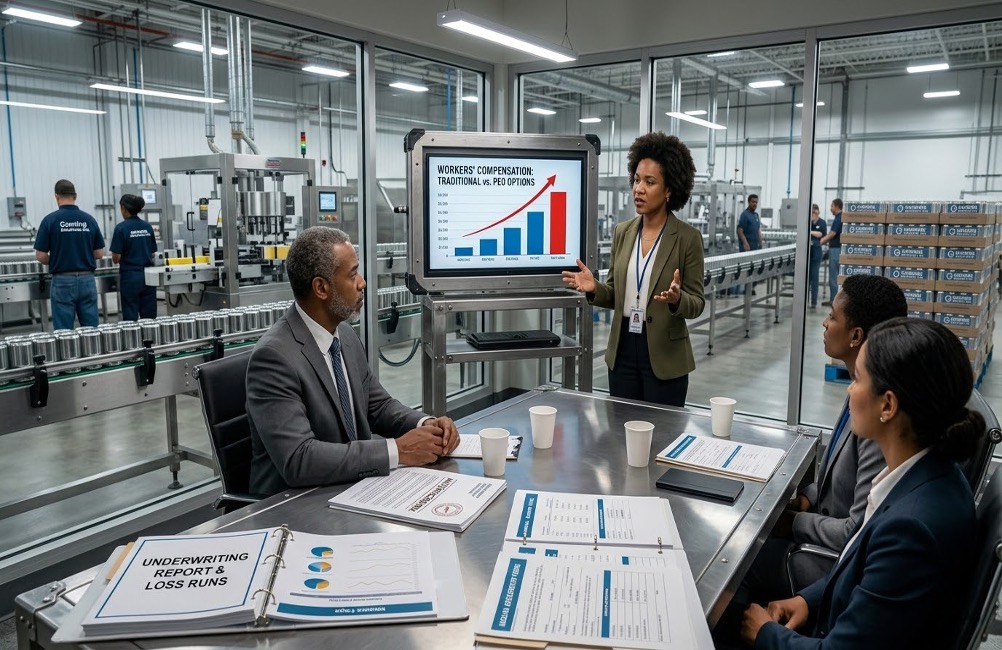
Many business owners assume workers’ compensation coverage works the same regardless of how the policy is structured. However, for companies operating in high-risk industries, the difference between a traditional workers’ compensation policy and a PEO workers’ compensation program can be substantial.
For insurance brokers, understanding these differences is essential when advising clients struggling with rising premiums, difficult renewals, or limited underwriting options.
While traditional workers’ compensation policies remain the right fit for many employers, PEO structures can provide additional operational advantages for businesses facing elevated risk exposure.
How Traditional Workers’ Compensation Policies Work
Under a traditional policy structure, the employer purchases workers’ compensation coverage directly through an insurance carrier. Premiums are based on payroll, class codes, claims history, and experience modification factors.
The employer remains fully responsible for:
- Payroll administration
- HR management
- Safety programs
- Claims coordination
- Compliance procedures
For low-risk businesses with stable operations, this structure often works well.
However, high-risk employers may encounter increasing underwriting pressure as claims activity grows.
Why Some Employers Explore PEO Programs
A PEO operates under a co-employment arrangement where certain administrative responsibilities are shared between the employer and the PEO.
In addition to workers’ compensation access, many PEOs provide support with:
- Payroll processing
- HR compliance
- Employee onboarding
- Safety coordination
- Claims management
- Return-to-work programs
For businesses experiencing operational strain, these services can create more structure and consistency across the organization.
This is particularly important in industries where injury exposure and labor turnover remain high.
The Underwriting Difference
One of the biggest distinctions between traditional coverage and PEO workers’ compensation programs involves underwriting perception.
Traditional carriers evaluate the employer independently based on its own payroll, claims history, and operational controls. If losses begin increasing, carrier options may shrink quickly.
PEO programs often provide broader administrative infrastructure that can help improve long-term risk management. While underwriting still matters, employers may gain access to operational systems designed to reduce claims frequency and improve reporting procedures.
For difficult-to-place businesses, that distinction can become extremely valuable.
Which Industries Commonly Use PEO Workers’ Compensation Programs?
PEO structures are especially common among employers operating in: Construction, Staffing, Manufacturing, Trucking, HVAC, Restoration, Landscaping, Seasonal labor industries.
These businesses often face fluctuating payrolls, higher injury exposure, and increased compliance complexity.
Many brokers use PEO solutions strategically when traditional markets begin tightening.
There Is No Universal “Best” Option
Some employers assume a PEO automatically lowers workers’ compensation costs. Others assume traditional policies are always simpler.
In reality, the best solution depends on:
- Claims history
- Payroll size
- Industry exposure
- Administrative capabilities
- Growth trajectory
- Safety culture
A well-run business with strong internal systems may prefer traditional placement. Another employer struggling with claims management and operational consistency may benefit significantly from PEO support.
The role of the broker is to evaluate both the insurance structure and the operational realities of the business.
Why Brokers Value PEO Solutions
For brokers handling difficult renewals, PEO workers’ compensation programs can create opportunities to preserve relationships that might otherwise be lost due to market restrictions.
More importantly, these programs often allow brokers to position themselves as long-term advisors instead of simply quoting policies each year.
Helping clients improve operational controls, stabilize claims performance, and navigate underwriting challenges builds stronger retention and deeper trust over time.
Traditional workers’ compensation policies and PEO workers’ compensation programs both serve important roles in the marketplace.
The key difference is that PEOs often provide additional operational infrastructure designed to support employers facing elevated workers’ compensation exposure.
For brokers working with high-risk industries, understanding when to introduce PEO solutions can make a significant difference in both client outcomes and long-term account retention.